


Welding has always meant being tethered to an outlet or a gas generator. Dragging extension cords across a job site, listening to a generator drone for hours — that's just part of the deal, right?
Not anymore.
Battery powered welding has moved from "science fair project" to genuinely usable technology. This guide breaks down what's actually possible in 2026, what works, what's still a gimmick, and how to build a real off-grid welding setup if you need one.
How Battery Powered Welding Works
A welding machine needs sustained high power output. A typical MIG welder drawing 200A at 25V requires around 5kW of continuous power. That's not a phone battery situation — you need serious energy storage.
The math:
- LiFePO4 battery cells store about 120-150Wh per kilogram
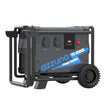
- A 2,662Wh portable power station (like the PS3500X) can theoretically run a small MIG welder for short periods
- Peak power matters more than rated capacity — many welders pull 2-3x their rated output during arc starts
Two approaches exist:
1. Direct battery-to-welder systems
Integrated units where the battery is built into the welder. These are limited in power but highly portable.
2. Portable power station + standard welder
Using a high-output battery power station to run a traditional welder. More flexible, higher power ceiling, but requires matching specs carefully.
What Actually Works in 2026
Integrated Battery Welders
These are self-contained units designed from the ground up for cordless operation.
| Feature | Typical Specs | Best For |
|---|---|---|
| Output range | 40-120A | Light fabrication, auto body, farm repairs |
| Battery | 20-50V lithium pack | Mobility prioritized |
| Duty cycle | 20-30% | Intermittent work |
| Weight | 15-30 lbs | Field work, mobile jobs |
Limitations: You won't run a 200A MIG machine off a battery pack. Current integrated units top out around 120A output, which handles 1/8" steel comfortably but struggles with 3/16"+ plate.
Portable Power Station + Standard Welder
This is where things get interesting. Pair a high-capacity power station with a dual-voltage welder.
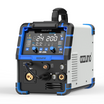
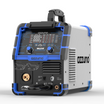
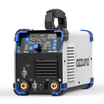
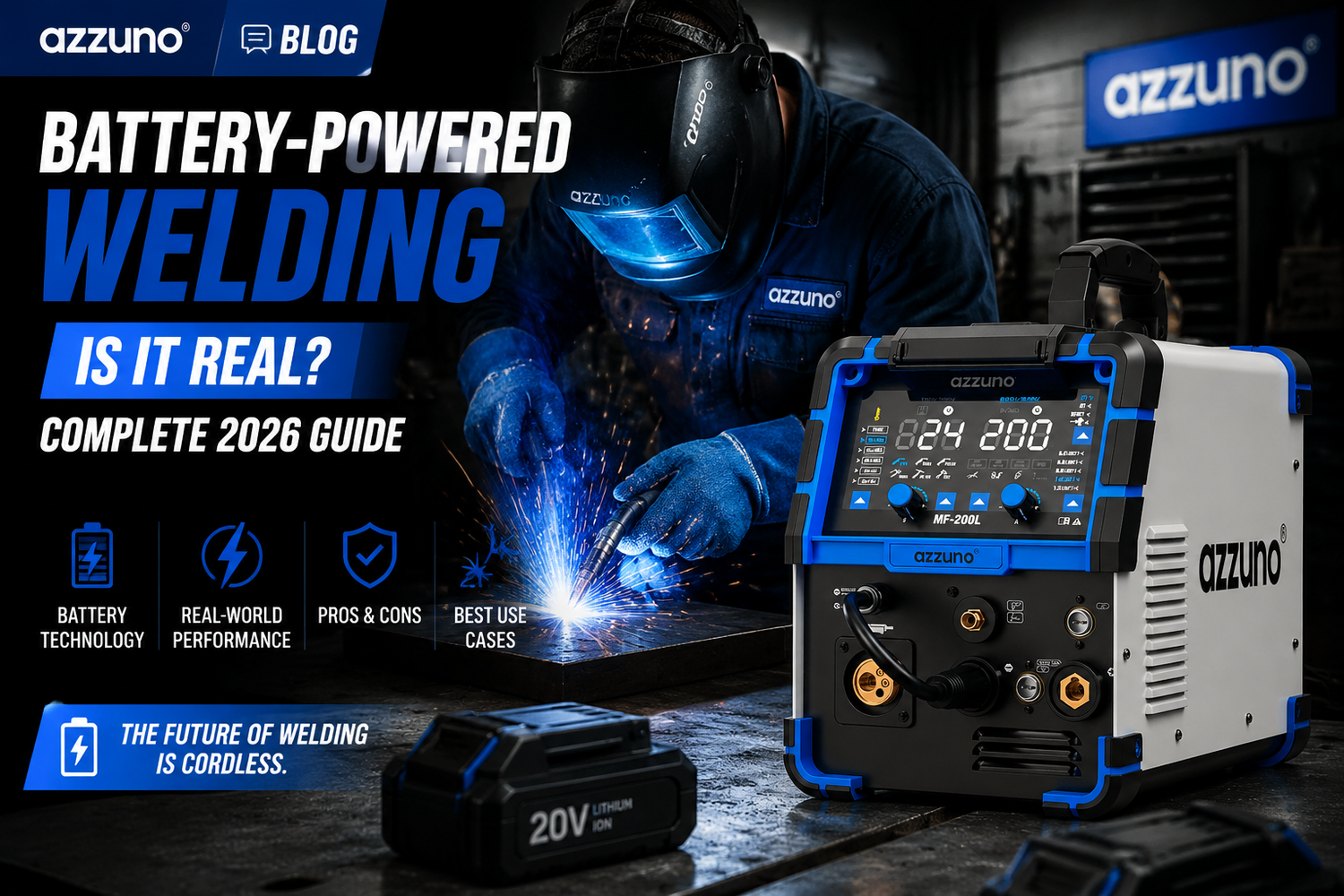
The PS3500X + MF-200L combination:
- PS3500X delivers 3,500W continuous / 7,000W peak output
- LiFePO4 chemistry means stable power delivery under load
- Pure sine wave output protects welder electronics
- MF-200L at 110V draws roughly 120A@15% duty cycle when MIG welding
What this setup can handle:
- MIG welding 1/8" to 3/16" steel (single pass)
- Flux core welding without gas
- Stick welding (TIG requires additional considerations)
- Plasma cutting lighter gauges (CUT-55L @ 35A on 110V)
What it won't handle reliably:
- Sustained high-amperage welding on thick material
- Running a 220V welder at full capacity
- Aluminum TIG (requires stable high-frequency power)
Real-World Use Cases
Garage Mike's Perspective
Mike runs a home workshop in suburban Ohio. He's been running conduit in his new garage — no power outlets where he needs them yet.
A battery power station lets him finish welding work without borrowing his neighbor's generator. He's not doing production welding — he's laying in beads on junction boxes and small frame pieces. The PS3500X + MIG-200F combo handles everything he needs.
"For my work, the battery setup is actually more convenient than plugging in. I can carry the welder exactly where I need it."
Ranch Hand Ryan's Perspective
Ryan manages equipment on a 500-acre ranch in Montana. When a tractor hydraulic fitting breaks in the back pasture, waiting for someone to haul a generator out isn't practical.
Ryan's setup: PS3500X with an MF-200L in his truck. He keeps flux core wire loaded — no gas bottles to manage. He can repair broken equipment, re-weld a gate hinge, or fix a trailer hitch on location.
"Diesel generators are loud and heavy. The battery is quiet, starts instantly, and I've got enough power to handle most repairs right there."
Maker Sarah's Perspective
Sarah runs a small custom fabrication shop, mostly artistic metalwork and custom furniture. She occasionally takes commissions on-site — a custom gate installation, a site-specific sculpture piece.
Carrying a battery station and a compact welder is lighter and simpler than loading a generator. The limitation is clear: she plans her work to avoid situations requiring sustained high-amperage passes.
"It's not about replacing my main setup. It's about having a capable option when I need to work off-grid."
The Honest Limitations
Battery powered welding isn't going to replace your shop setup. Here's where it falls short:
Duty cycle constraints
Most battery-welder combinations struggle with extended welding sessions. If you're burning beads for 30 minutes straight, you'll hit thermal limits or drain the battery faster than expected.
Thick material limits
3/16" steel is realistic. 1/4" plate becomes slow and frustrating. Anything heavier and you're better off waiting for a generator or shop power.
No gas MIG limitations
Running gas-shielded MIG requires carrying shielding gas bottles. Battery setups pair better with flux core wire, which doesn't need external gas.
Cost considerations
A capable battery power station ($1,500-3,000) plus a dual-voltage welder ($500-1,500) is a significant investment. Only makes sense if you genuinely need off-grid capability.
Setting Up Your Battery Welding System
Step 1: Match Power Requirements
Check your welder's 110V input specifications:
- Look for "110V input" or "dual voltage" labeling
- Note the amperage draw at 110V operation
- The power station's continuous output rating should exceed the welder's input draw by 20-30%
Step 2: Choose Your Welder
For battery-compatible setups, prioritize:
- Dual voltage capability (110V/220V)
- Flux core compatibility (no gas bottles needed)
- Synergic mode (automatically adjusts wire feed based on material thickness)
- Reasonable duty cycle (50%+ preferred for 110V operation)
The MF-200L checks all these boxes. At 110V it delivers 120A@15% for MIG, enough for garage and field work on light-to-medium material.
Step 3: Select Your Power Station
Minimum requirements:
- 3,000W continuous output minimum for reliable welding
- Pure sine wave output (modified sine wave damages electronics)
- LiFePO4 battery chemistry (longer cycle life, safer than NMC)
- High surge/peak rating (arc starts pull 2-3x normal draw)
The PS3500X (3,500W continuous / 7,000W peak, 2,662Wh, LiFePO4) sits at the sweet spot for most welding applications.
Step 4: Configure Your Setup
- Charge the power station fully before heading out
- Set the MF-200L to 110V mode
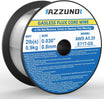
- Load flux core wire (.030" or .035" diameter)
- Adjust wire feed speed and voltage according to material thickness
- Keep work pieces relatively clean — battery setups work best on prepped metal
Battery Powered vs Gas Generator: A Quick Comparison
| Factor | Battery Powered (PS3500X) | Gas Generator |
|---|---|---|
| Weight | 45 lbs | 80-150+ lbs |
| Noise | Near silent | 65-80+ dB |
| Operating cost | Electricity only | Fuel + maintenance |
| Startup time | Instant | Pull start / electric |
| Power stability | Pure sine, stable voltage | Varies with load |
| Fuel dependency | None | Gas/diesel required |
| Indoor use | Safe | Ventilation required |
| Max weld output | 120A @ 110V | Varies (often higher) |
| Runtime | 2-4 hours welding | Until fuel runs out |
| Environmental | Zero emissions | Emissions present |
Frequently Asked Questions
Can you actually weld with a battery?
Yes, but with realistic expectations. Battery powered welding works for light-to-medium fabrication (up to 3/16" steel), field repairs, and mobile work. It won't replace a 220V shop setup for production welding on thick material.
How long can a battery power station run a MIG welder?
With a 2,662Wh station like the PS3500X and a typical 110V MIG welder drawing 1,500-2,000W during active welding, expect 1-2 hours of actual welding time. Actual runtime depends on duty cycle, material thickness, and bead length.
What's the best welder for battery/off-grid use?
Look for dual-voltage welders with strong 110V performance. The MF-200L offers 120A@110V in MIG mode with flux core capability, making it well-suited for battery setups. The MIG-200PRO adds aluminum capability if you need that later.
Can I run a 220V welder off a battery power station?
Generally not recommended. Most portable power stations max out at 220V output, and running a 220V welder at full capacity requires more power than battery stations practically provide. Stick to 110V mode for battery compatibility.
Is battery welding ready for professional use?
For field service technicians, ranchers, and mobile fabricators — yes, battery welding is a legitimate option. For production welding shops or heavy industrial work — not yet. The technology is improving rapidly, but duty cycle and power limits remain.
What battery chemistry is best for welding power stations?
LiFePO4 (Lithium Iron Phosphate) is the preferred chemistry. It offers longer cycle life (2,000+ cycles to 80% capacity), better thermal stability, and no risk of thermal runaway compared to NMC lithium batteries.
The Bottom Line
Battery powered welding is real in 2026. It's not a replacement for shop welding on heavy production work, but for anyone who needs to weld off-grid — ranchers, mobile technicians, builders working in remote locations — the technology has reached genuinely useful capability.
The PS3500X + MF-200L combination gives you a capable off-grid welding system: 3,500W continuous output, pure sine wave power, 2,662Wh capacity, and a 5-in-1 welder that handles MIG, flux core, TIG, stick, and plasma cutting.
If you're doing field repairs on light-to-medium material, this setup will handle your work. Plan around the duty cycle, bring extra wire, and you'll have welding capability anywhere without dragging a generator along.
Start welding anywhere — no outlet required.
Author: James Chen, Welding Equipment Specialist at Azzuno Tools


Leave a comment
This site is protected by hCaptcha and the hCaptcha Privacy Policy and Terms of Service apply.