


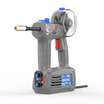

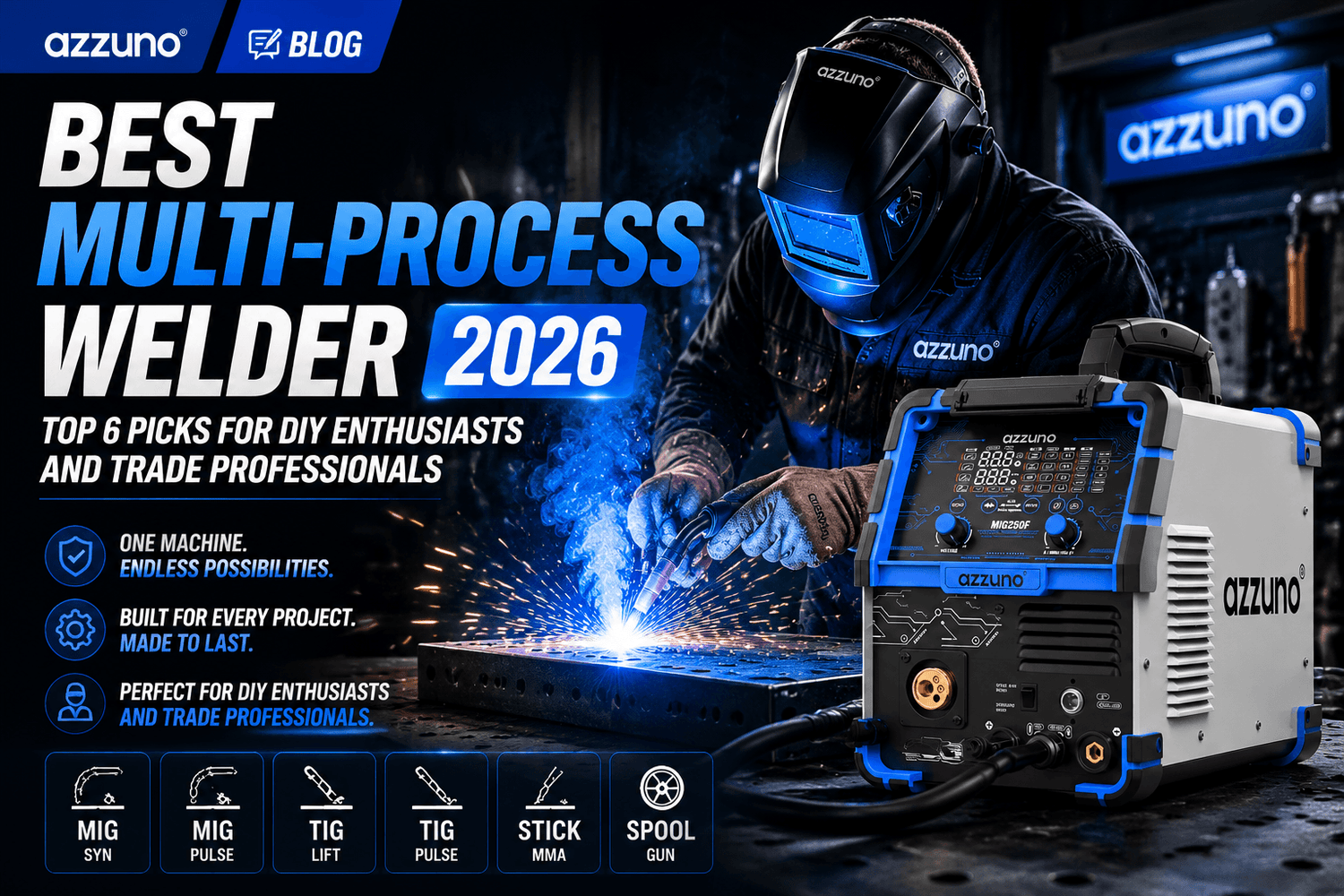
Let's be honest: if you're reading this, you've probably spent longer than you'd like comparing welding machines. There are dozens of brands, hundreds of models, and at least as many conflicting opinions online. You just want to know which multi-process welder is actually worth your money in 2026.
That's what this guide is for. I narrowed it down to six machines that cover the full range—budget entry points, mid-range workhorses, and serious professional rigs. No fluff, no "game-changing" language, just specs, real tradeoffs, and which type of buyer each machine fits best.
What Is a Multi-Process Welder, and Why Would You Want One?

A multi-process welder combines two or more welding processes—typically MIG, flux-core (FCAW), stick (MMA), and TIG—into a single machine. Instead of buying a dedicated MIG rig, a dedicated stick welder, and a TIG machine, you get one box that switches between modes.
The appeal is obvious if you work across different materials and projects. Ranch repairs might need stick welding. A custom gate build calls for MIG. Aluminum fabrication needs TIG. One machine handles all three. The tradeoff is that no single mode on a multi-process machine is usually as optimized as a dedicated single-process welder at the same price point—but the flexibility usually wins for anyone working in a small shop or field environment.
According to the American Welding Society (AWS), the combination of MIG and flux-core welding accounts for roughly 70% of all industrial welding work in North America. Multi-process machines covering those two modes already handle the majority of real-world jobs.
What to Look for in a Multi-Process Welder in 2026
Before the picks, here are the specs that actually matter:
Duty cycle — The percentage of a 10-minute window a machine can run at full amperage before needing to cool down. A 60% duty cycle at 200A means you can weld for 6 minutes, then need 4 minutes of cooling. Higher is better if you're doing production work. Many budget machines list high duty cycles but only at reduced amperage—check the fine print.
Dual voltage (110V/220V) — 110V lets you run on standard household outlets. 220V unlocks full amperage. If you work in the field or don't have 220V available, dual voltage is close to mandatory.
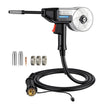
Wire compatibility — Check what wire diameters and types each machine handles. Most multi-process welders accept 0.023", 0.030", and 0.035" solid and flux-core wire. Aluminum welding typically requires a spool gun add-on and specific wire diameters (0.035" or 0.047").
Synergic vs. manual control — Synergic mode automatically adjusts wire feed speed and voltage based on material thickness you select. This dramatically cuts the learning curve for beginners. Manual mode gives experienced welders more precise control.
Weight and form factor — If you're moving the machine between jobs, every pound counts. Most multi-process welders in this range weigh between 25-45 lbs.
Best Multi-Process Welder 2026: Top 6 Picks
1. Best Overall — Azzuno MF-200L (From $399.99)
Best for: DIYers and hobbyists who want maximum versatility in a single machine, including plasma cutting.
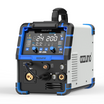
The MF-200L is Azzuno's flagship 9-in-1 machine. Starting at $399.99, it covers flux-core MIG, gas MIG, pulse MIG, MAG, spot welding, plasma cutting, HF TIG, stick, and spool gun compatibility. That's more process coverage than most machines at twice the price—including a built-in plasma cutter that can cut up to 9/16" (14mm) steel.
On 220V, it delivers 200A with a 60% duty cycle at 150A. On 110V, you're looking at roughly 120A—enough for most garage and light farm work. The synergic MIG mode handles material thickness selection automatically, which makes it genuinely usable for beginners who don't want to memorize charts.
The weight is 29 lbs—light for a machine this capable. It accepts 1-10 lb wire spools and handles solid wire (.023"/.030"/.035"/.040"), flux-core wire (.023"/.030"/.035"/.040"), and aluminum wire (.035"/.040"/.047" ER5356).
The fan runs constantly during operation—expected behavior for this design, not a defect, though it can be noticeable in quiet environments.
What you don't get: memory channels for saving parameter presets, and aluminum MIG requires the spool gun as an add-on purchase (same as most competitors at this price).
At $399.99, you're getting a MIG welder and a plasma cutter in one box. If you priced a 200A MIG machine and a separate plasma cutter, you'd be well over $500.
2. Best for Beginners — Azzuno MF-160PRO (From $319.99)
Best for: First-time welder buyers who want a safe entry point with plasma cutting included.
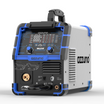
The MF-160PRO is Azzuno's 5-in-1 entry model starting at $319.99. It covers flux MIG, gas MIG, HF TIG, stick, and plasma cutting. The plasma cutting feature delivers 40A on 220V—useful for fitting and prep work where you'd otherwise reach for an angle grinder, and it can cut up to 9/16" (14mm) steel.
At 220V it puts out 160A with a 25% duty cycle. That's the honest spec: 25%, not the inflated numbers some competitors cite at reduced amperage. At 110V you're working with 120A. For garage-scale projects—thin steel, trailer hitches, farm equipment panels—it's adequate.
The synergic MIG mode is where this machine earns its place. You select material thickness, and the machine sets wire speed and voltage. It removes most of the intimidation factor that stops people from actually starting to weld.
Weight is 28.5 lbs—easy to move between workstations or load into a truck. If you're not sure whether you'll stick with welding as a hobby, the MF-160PRO is a lower-risk way to find out than buying separate machines for each process.
3. Best Value 8-in-1 — Azzuno MIG-200PRO (From $299.99)
Best for: Users who need aluminum capability and broad process coverage at the lowest price point.
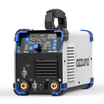
The MIG-200PRO is an 8-in-1 machine starting at $299.99, making it the most affordable way into Azzuno's full multi-process lineup. It covers gas MIG, flux-core, MAG, aluminum MIG, spot welding, lift TIG, stick, and spool gun compatibility.
On 220V it delivers 40-200A with a 50% duty cycle. The 50% figure is more honest than the 25% you'll find on budget machines, and it matters if you're doing real fabrication work rather than hobby sessions.
The spool gun compatibility is included out of the box—this is where it differentiates from the MF series. If aluminum fabrication is on your roadmap, this machine gets you there without buying a separate aluminum MIG setup. It also includes adjustable inductance (−10 to +10) which experienced MIG users use to fine-tune arc characteristics for different joint types and positions.
It supports solid wire (.023"/.030"/.035"/.040"), flux-core wire (.023"/.030"/.035"/.040"), and aluminum wire (.035"/.040" ER5356). The Teflon liner for aluminum welding is included in the package.
Memory channels are absent, which is the main gap versus professional-tier machines. If you're doing the same parameters repeatedly throughout a workday, you'll be adjusting manually each time.
At $299.99, it undercuts the MF-200L by $100 while adding spool gun compatibility out of the box. The tradeoff is no plasma cutting—if you need that, the MF-200L is the better buy.
4. Best High-Power Option — Azzuno MIG-250F (From $359.99)
Best for: Serious fabricators and trade workers who need 250A peak output and broad process coverage.
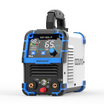
The MIG-250F is the highest-amperage multi-process machine in Azzuno's lineup. It's a 6-in-1 covering gas MIG, flux-core MIG, spool gun MIG, stick, and lift TIG, with both synergic and manual MIG modes.
On 220V it delivers 50-250A with a 40% duty cycle at full amperage. That's real power for thicker materials—10mm and beyond. The dual voltage design means 110V operation caps at around 135A MIG, but for most field work that's still usable on standard circuits.
It has a fan cooling system, IP21 protection rating, and includes VRD (Voltage Reduction Device) for stick welding safety in damp environments. The anti-stick and hot start features help with difficult electrodes, which you'll appreciate when working with 6011 or 7018 in outdoor or field conditions.
Wire compatibility spans solid wire (.023"/.030"/.035"), flux-core wire (.030"/.035"), aluminum wire (.035"/.040"/.045"), and copper wire (.035"/.040"). The Teflon liner for aluminum welding is included, and spool gun support is built in.
The size (approximately 450×238×310mm) puts it in the "shop machine" category rather than something you'd regularly move between job sites. If your work is site-based or you have a dedicated workshop, this is where you stop looking for more power.
At $359.99, it's only $60 more than the MIG-200PRO while delivering 50A more peak output and wider wire compatibility including copper welding.
5. Best for Professional Shops — Lincoln Electric 210 MP (~$799)
Best for: Professional welders and small fabrication shops with a bigger budget.
The Lincoln 210 MP is the established professional benchmark in the multi-process category. It covers MIG, flux-core, stick, and TIG, with True Voltage Technology that automatically compensates for input voltage variation to maintain stable arc conditions.
The 210A output handles most commercial and light industrial work. The arc is consistent—Lincoln's reputation in this space is well-earned. Where it pulls ahead of budget machines is in the details: wire drive system quality, contact tip life, and the overall consistency of the output across extended sessions.
The tradeoff is price. At roughly $799, it's three times the cost of the Azzuno MF-200L. For a hobbyist, that premium is hard to justify. For someone running a small fabrication business where machine downtime costs money, Lincoln's reliability and dealer support network justify the investment.
It weighs around 42 lbs—on the heavier side, which is typical for machines built to professional durability standards.
If you've been welding for a while and know exactly what you need from a machine, the 210 MP is the safe answer. Just be prepared for the price.
6. Best Budget Professional Pick — Hobart Handler 210 MVP (~$549)
Best for: Users who want professional-tier quality without the Lincoln price tag, and primarily weld mild steel.
The Hobart Handler 210 MVP sits in the gap between budget import machines and professional-grade equipment. Hobart is owned by Lincoln Electric, so you get much of the quality engineering at a lower price point.
It runs MIG, flux-core, and stick, with an infinite voltage adjustment control that gives experienced users more precise arc tuning than the preset-style controls on budget machines. The auto-set feature adjusts parameters for you if you prefer not to fiddle with dials.
The arc quality on MIG is where Hobart machines consistently outperform their price. The wire feed is smooth and consistent, which matters more than you'd think when you're laying long beads on a fabrication project.
It's single-voltage (220V only)—this is the honest limitation. If you need to run on 110V, look elsewhere. The Handler 210 MVP assumes you have access to 220V power, which is a reasonable assumption for most shop environments but a dealbreaker for field work.
At $549, it's competitive with the Azzuno MIG-200PRO and MIG-250F on price while delivering Hobart's build quality and support infrastructure.
Multi-Process Welder Comparison Table
| Welder | Max Amps (220V) | Duty Cycle | Voltage | Processes | Weight | Price |
|---|---|---|---|---|---|---|
| Azzuno MF-200L | 200A | 60% @ 150A | 110V/220V | 9-in-1 (w/ plasma) | 29 lbs | From $399.99 |
| Azzuno MF-160PRO | 160A | 25% | 110V/220V | 5-in-1 (w/ plasma) | 28.5 lbs | From $319.99 |
| Azzuno MIG-200PRO | 200A | 50% | 110V/220V | 8-in-1 | ~30 lbs | From $299.99 |
| Azzuno MIG-250F | 250A | 40% | 110V/220V | 6-in-1 | ~55 lbs | From $359.99 |
| Lincoln 210 MP | 210A | 30% | 220V only | 4-in-1 | 42 lbs | ~$799 |
| Hobart Handler 210 MVP | 210A | 30% | 220V only | 3-in-1 | 38 lbs | ~$549 |
The Three Personas, Applied
Garage Mike (DIY Garage, 32-50 years old)
Mike rebuilt his '72 Nova in his garage over four years. He needs one machine that handles his random project mix: chassis repairs, custom brackets, occasional fence work.
The **Azzuno MIG-200PRO at $299.99** is his machine. He doesn't need memory channels because no two projects use the same settings. He doesn't need 250A because most of his work is 3-16ga steel. The synergic mode means he can switch from a flux-core fence rail repair to a MIG exhaust patch without re-learning the machine each time. And at $299.99, it leaves room in the budget for a better helmet and consumables.
If Mike wants plasma cutting capability down the line, the MF-200L at $399.99 adds that and more processes in one box.
Ranch Hand Ryan (Farm and Field Work, 28-55 years old)
Ryan drives between three properties doing equipment repair. His truck is his workshop. Power availability is unpredictable—sometimes 220V, sometimes 110V, sometimes a generator.
The Azzuno MIG-200PRO or MIG-250F fits his situation, depending on how thick the materials are. For general farm equipment (fenders, hitches, panels), the MIG-200PRO at $299.99 covers it. If he's doing heavier structural repairs on older equipment, the MIG-250F's 250A peak makes cleaner work of thick plate.
The dual voltage is non-negotiable for Ryan. The size difference between the two machines is real but manageable when you're loading and unloading a truck regularly.
The budget math is simple: at $299.99-359.99, either machine costs less than a single day of downtime on a broken piece of equipment if he had to wait for a mobile welding service.
Maker Sarah (Small Business Fabricator, 22-40 years old)
Sarah runs a custom metalwork business from a rented shop. She makes gates, furniture, and decorative pieces. Her clients want mild steel mostly, occasionally aluminum.
The Azzuno MIG-200PRO at $299.99 is her practical choice. Spool gun compatibility ships with this model—aluminum jobs come up occasionally and she can handle them without a separate machine. The 50% duty cycle handles a full day of gate fabrication without forcing breaks.
If she were doing high-volume production work, the Lincoln 210 MP's arc consistency would save her time and wire over years of use. But at her current scale, the MIG-200PRO leaves her with money to invest in consumables, a better table, or marketing.
How to Choose
Here's the short version:
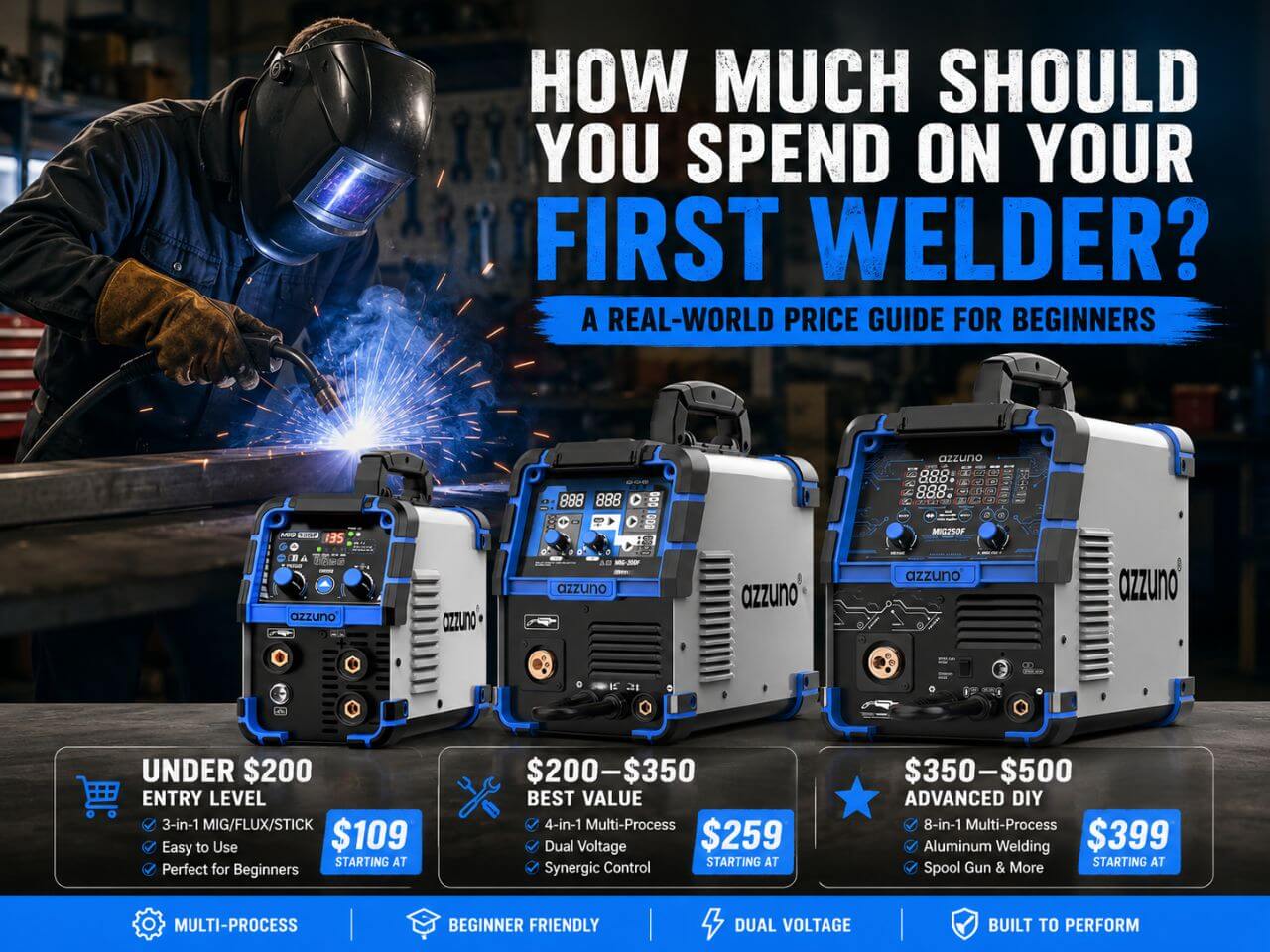
- Around $300, best value 8-in-1 → Azzuno MIG-200PRO. Synergic MIG, 8 processes, 50% duty cycle, spool gun ready. Best features-per-dollar in the lineup.
- Around $320, entry with plasma cutting → Azzuno MF-160PRO. 5-in-1 including plasma cutter. Lower amperage (160A) but more versatile than a MIG-only machine.
- Around $360, need 250A+ → Azzuno MIG-250F. Highest amperage in this roundup. Shop machine, not a field rig.
- Around $400, maximum versatility → Azzuno MF-200L. 9-in-1 with plasma cutting, pulse MIG, and HF TIG. The complete workshop in one box.
- $550-800, professional shop → Hobart Handler 210 MVP or Lincoln 210 MP. Better arc quality and build durability. Single voltage limits field use.
Frequently Asked Questions
What is the best multi-process welder for a beginner?
The Azzuno MIG-200PRO and MF-160PRO are both strong choices for beginners. Both include synergic MIG mode, which automatically sets wire speed and voltage based on material thickness. This removes the steepest part of the learning curve. The MIG-200PRO offers more processes (8-in-1) and spool gun compatibility at $299.99, while the MF-160PRO adds plasma cutting (5-in-1) at $319.99.
Can multi-process welders do TIG welding?
Yes. All multi-process welders in this guide include stick welding and MIG/flux-core as standard. TIG capability varies. The Azzuno MF-160PRO and MF-200L include HF-TIG mode (high-frequency start, suitable for thin materials and cleaner arc initiation). The MIG-200PRO and MIG-250F support lift-TIG mode. For serious TIG work, dedicated TIG machines offer better arc quality and control.
Is 110V enough for multi-process welding?
For light to medium work: yes. On 110V, most dual-voltage machines deliver 35-60% of their rated amperage—typically 35-140A depending on the model. That's enough for sheet metal, thin plate (up to about 1/4"), and field repairs. For heavy plate (3/8" and up) or production welding, 220V is strongly recommended.
What duty cycle do I actually need?
For hobby and occasional garage work: 25-30% is adequate. For semi-regular farm or shop use: 40-60% is more comfortable. For production or professional fabrication: aim for 50% or higher at your typical operating amperage. Watch the fine print—some machines list duty cycle at reduced amperage (e.g., "60% at 130A" but only 25% at 200A). All specs in this guide are noted at the amperage they apply to.
Do I need a spool gun for aluminum welding?
Yes, for gas-shielded aluminum MIG welding you need a spool gun. The spool gun keeps the aluminum wire from kinking or rubbing against the standard feed rollers, which causes feeding problems. On the MIG-200PRO and MIG-250F, spool gun is a compatible add-on (LBT150 model). The MF-200L also supports spool gun as an add-on. Alternatively, all three machines support aluminum MIG through the MIG torch with the included Teflon liner.
Which welder has the best warranty?
Most budget brands (including Azzuno) offer 2+1 year warranties on their multi-process welders (2 years standard + 1 year extended). Lincoln and Hobart typically offer 3-5 year warranties on professional models. Direct purchase from the manufacturer (rather than through a third-party marketplace) generally results in faster warranty claim resolution.
Where can I buy Azzuno multi-process welders?
The full Azzuno lineup is available at azzunotools.com with current pricing, specs, and direct customer support. Amazon availability varies by model.
Author: AZZUNO Technical Team | Editor: Content Team

Leave a comment
This site is protected by hCaptcha and the hCaptcha Privacy Policy and Terms of Service apply.