



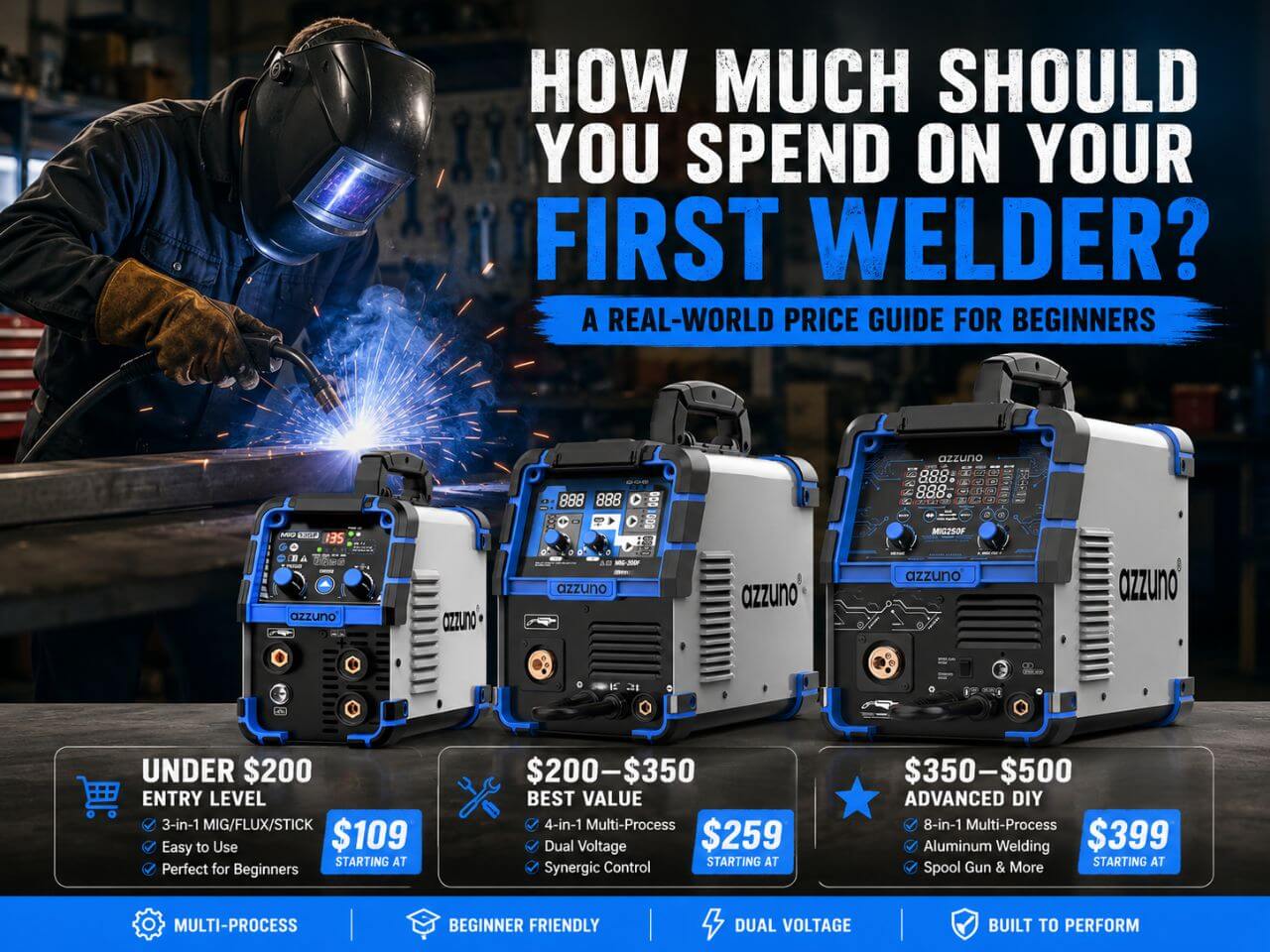
If you have been scrolling through welder listings, you have seen the range. $99 flux core machines on one end. $3,000 professional rigs on the other. It is confusing and nobody explains the middle ground in a way that actually helps.
So here is the honest answer. Most beginners, DIYers, mechanics, and garage fabricators do not need to drop $1,500 to start welding well. The inverter tech that has hit the market in the last few years changed the math completely. Synergic controls. Digital displays. Dual voltage. Multi-process capability. Stuff that was pro-only a decade ago now shows up on machines that cost less than a decent set of tires.
For a first welder in 2026, the range that makes sense is about $100 to $500. Where you land inside that depends on what you are actually going to build. Not what looks cool. Not what YouTube says. What is sitting in your garage waiting to get fixed.
Under $200: A Real Entry Point Now
Five years ago, spending under $200 meant you were getting a toy. That has changed.
Modern entry-level inverter machines are genuinely capable now. No, they are not production units. But for learning basics, home repairs, light fabrication, farm maintenance, and getting your feet wet with automotive work — they do the job.
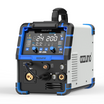
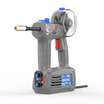
Take something like the Azzuno 135A 3-in-1. Flux core MIG, stick, and lift TIG in a single unit. Synergic control so you are not guessing at settings. Starts under $110. That is not a typo. A few years back you would have paid triple for that feature set.
Is the wire feed as smooth as a $400 machine? No. Is the duty cycle going to let you run beads for an hour straight? Also no. But for someone who wants to try welding without committing a mortgage payment, this tier is a legitimate starting point now.

$200–$350: Where Most People Should Be Looking
This bracket is where things get versatile in a way that actually matters.
At $200 to $350, dual voltage becomes standard. That means you plug into a regular 110V wall outlet and start welding. Six months later, if you run a 220V line to the garage — or use the outlet your dryer is plugged into — the same machine wakes up with a lot more power. You are not buying a new welder. You are just using what was already there.
Gas MIG shows up at this level too. That is the difference between flux core spatter everywhere and clean beads that look good right off the gun. You also get lift TIG, stick, digital displays, and synergic controls that take the guesswork out of setup.
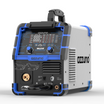
The Azzuno MIG-200F 4-in-1 is a solid example. MIG, flux core, lift TIG, stick. Dual voltage. Synergic control. It is not going to do pulse aluminum, but for a home workshop or garage fabrication setup, it covers years of projects without feeling limiting.
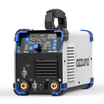
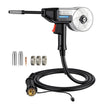
If you want even more room to grow, the Azzuno MIG-200PRO packs eight processes into the same footprint. Aluminum MIG with spool gun support. Spot welding mode. Everything in the 4-in-1 plus extras you may not need today but probably will in a year or two.
For most DIY welders and home fabricators, this is the range that makes the most sense. Enough capability to be enjoyable. Not so much that you are paying for pro features that gather dust.
$350–$500: Serious Capability, Not Professional Pricing
Cross $350 and you start seeing features that used to live exclusively on machines costing three or four times as much.
Higher amperage — 200A and up, enough for quarter inch plate and then some. Aluminum welding support with spool gun compatibility. Larger wire capacity. Better duty cycles meaning you can run longer without the thermal protection cutting in. More welding modes. Real multi-process flexibility.
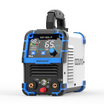
The Azzuno MIG-250F is a good look at what this tier delivers. 250 amps on 220V. Six processes — gas MIG, flux core, stick, lift TIG, spot welding, and spool gun welding. It handles aluminum and copper. Dual voltage. And it sits inside a housing compact enough for a home workshop.
For someone regularly working on trailers, automotive fabrication, farm equipment, or heavier steel projects, this is the tier where the machine stops being the limitation.

Do Beginners Need a $1,000+ Welder?
Probably not. And that is not a knock on expensive welders. They are amazing. They are also overkill for almost everyone reading this.
Professional fab shops need continuous production duty cycles. Water-cooled torches. Advanced pulse systems. Industrial component grades built for three shifts a day, five days a week. That is what the $1,000+ bracket delivers and it is worth every penny if that describes your workflow.
It does not describe a garage. It does not describe a farm shop. It does not describe a weekend fabricator.
The modern multi-process inverter machines in the $200 to $500 range will complete the same projects. Not as fast. Not as relentlessly. But they will finish them. Save t
he extra $500 to $2,000 for gas, wire, a good helmet, and a project list.
Why Multi-Process Makes Sense for a First Machine
The single biggest mistake beginners make is buying a machine that only does one thing.
You start with flux core. A month in, you want to try gas MIG because you are tired of spatter everywhere. Two months after that, a buddy needs help fixing a rusty gate and stick welding is the only thing that works on dirty metal. Six months in, you want to try TIG on a stainless project.
If you bought a single-process machine, you are buying a new welder at each of those steps. That adds up fast.
Multi-process welders solve this. One machine. Multiple methods. You try different processes as your curiosity and skills grow. You do not commit your whole budget to one direction on day one.
Machines like the Azzuno MIG-200PRO and MIG-250F let you explore MIG, flux core, stick, TIG, and aluminum without switching equipment. For a beginner, that flexibility is worth more than an extra 20 amps on a spec sheet.
Features Worth Caring About
Welder listings throw a lot of numbers at you. Here is what actually matters.
- Dual voltage. Start on 110. Upgrade to 220 later. Same machine. Way more power when you are ready.
- Synergic controls. Tell the machine your material and wire size. It sets the parameters. You focus on technique instead of chasing knobs. You can go manual whenever you want.
- Already covered this. One machine. Many methods. Do not box yourself in.
- Aluminum capability. You might not need it today. A year from now? Maybe. If aluminum is even a distant possibility, look for spool gun support. Adding it later means buying a new welder.
- Stable arc. This matters more than max amps. Read reviews for words like "smooth" and "consistent." That tells you more than any spec number.
Which Azzuno Fits Your Budget
Just getting started — $109. The 135A 3-in-1 with synergic control. Flux core MIG, stick, and lift TIG. 110V. Compact. For learning, home repairs, and small projects. A real entry point, not a toy.
Home workshop — under $250. The MIG-200F 4-in-1. Dual voltage. Gas MIG, flux core, stick, lift TIG. Synergic controls. The garage workhorse for most people reading this.
Room to grow — under $350. The MIG-200PRO 8-in-1. Everything in the 4-in-1 plus aluminum MIG, spool gun support, spot welding. For someone who knows they will want more capability down the road.
Heavy duty DIY — under $500. The MIG-250F 6-in-1. 250 amps. Aluminum and copper. Spool gun ready. For trailers, farm equipment, thick steel, and fabrication work that needs real heat.
So How Much?
$100 to $200 gets you in the door. A real machine. Enough to learn and handle home repairs.
$200 to $350 is the value sweet spot for most people. Dual voltage. Multi-process. A welder you will enjoy using and not outgrow fast.
$350 to $500 gives you advanced capability — aluminum, higher output, more processes — without touching professional pricing.
The bottom line: modern inverter welders have made quality welding accessible at almost any budget. Pick a versatile multi-process machine that fits your wallet. Start welding. Upgrade when your skills demand it, not before.


Leave a comment
This site is protected by hCaptcha and the hCaptcha Privacy Policy and Terms of Service apply.