


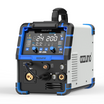
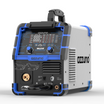
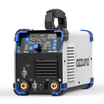
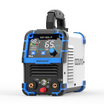
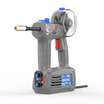

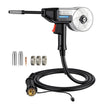
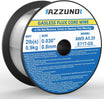
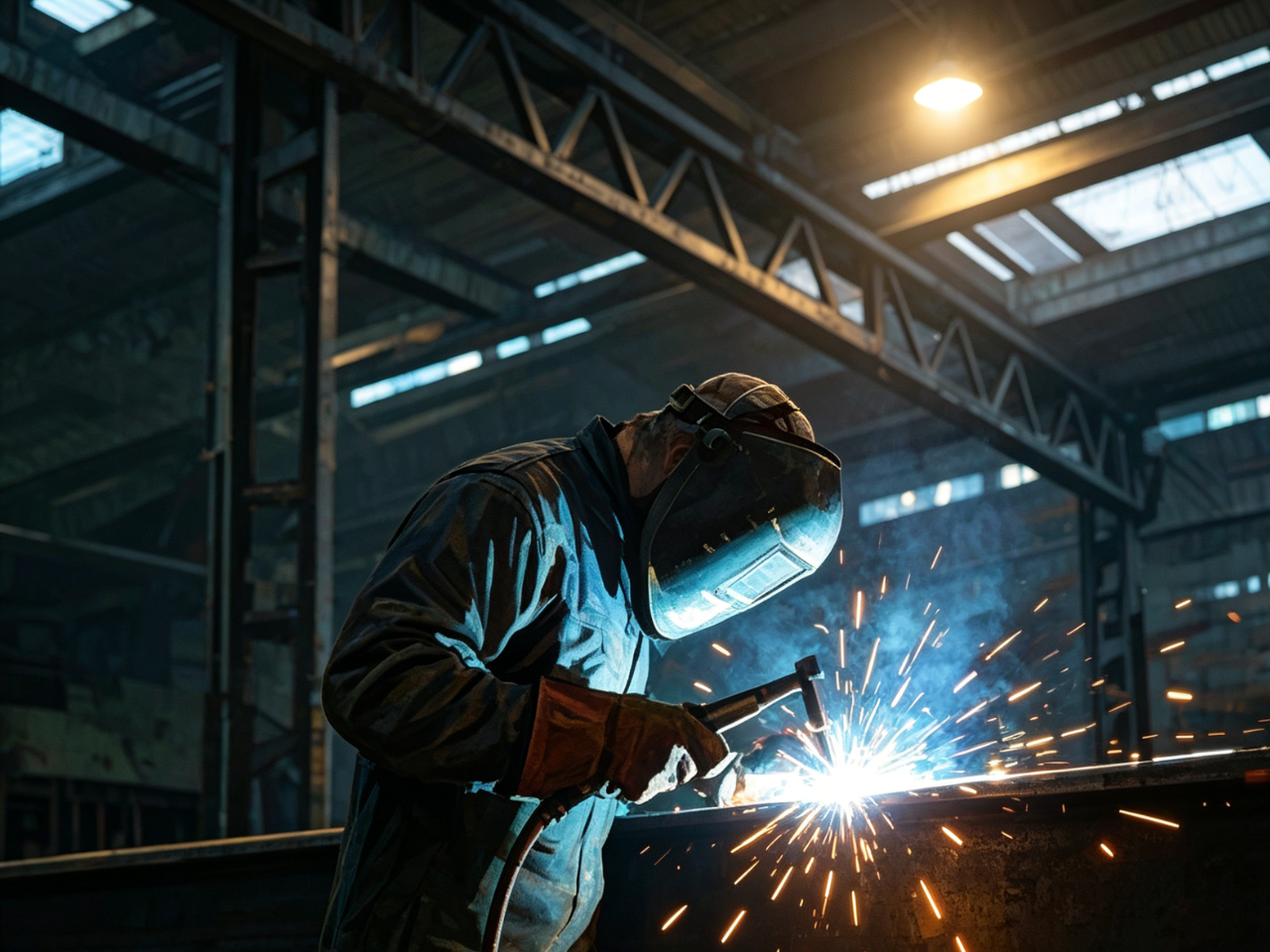
Quick Answer: Yes, you can weld aluminum with a MIG welder — but only if the machine supports a spool gun and you use pure argon shielding gas with ER4043 or ER5356 aluminum wire. Standard MIG setups with a push-feed torch will jam constantly because aluminum wire is too soft to push through a long liner. A spool gun eliminates that problem by feeding wire from a mini-spool just inches from the arc. The result is fast, clean aluminum welds without the frustration.
Table of Contents
- Why MIG Welding Aluminum Is Tricky
- The Spool Gun Solution
- MIG vs. TIG for Aluminum: Which Is Right for You?
- What You Need to MIG Weld Aluminum
- Step-by-Step: How to MIG Weld Aluminum
- Voltage & Wire Speed Settings Chart
- 5 Common Mistakes (and How to Avoid Them)
- Best AZZUNO MIG Welders for Aluminum
- Frequently Asked Questions
- Conclusion
1. Why MIG Welding Aluminum Is Tricky
Aluminum looks simple — it's lightweight, corrosion-resistant, and welds quickly once you get it right. But it has two properties that make standard MIG welding a nightmare:
Problem #1: Soft Wire Jams the Liner
Aluminum wire (ER4043/ER5356) is much softer than steel wire. In a conventional MIG gun, the wire travels through 10–15 feet of liner tubing before reaching the arc. That's plenty of distance for soft aluminum wire to buckle, "bird-nest," and jam — often every few minutes. You'll spend more time clearing jams than actually welding.
Problem #2: Aluminum Needs Pure Argon Gas — Not C25
The C25 gas (75% Argon / 25% CO₂) you use for steel welding will contaminate aluminum welds. CO₂ oxidizes aluminum at welding temperatures, causing porosity (tiny holes) and a rough, black weld surface. Aluminum requires 100% pure argon shielding gas.
Problem #3: Aluminum Oxidizes Instantly
Aluminum forms an oxide layer (Al₂O₃) on its surface within seconds of exposure to air. This oxide melts at 3,700 °F — nearly triple the melting point of the aluminum beneath it. You must remove the oxide layer by brushing with a dedicated stainless steel brush before welding, every single time.
💡 Key Insight: None of these problems are deal-breakers. They're just setup requirements. Get them right once, and MIG welding aluminum is actually faster than TIG for most jobs.
2. The Spool Gun Solution
A spool gun is the standard professional solution to the wire-jamming problem. Instead of pushing wire through a long liner, the spool gun has a small built-in wire spool — typically holding 1 lb of wire — mounted directly in the gun handle. The feed distance drops from 15 feet to just 2–3 inches.
Spool Gun vs. Standard MIG Torch: Side-by-Side
| Feature | Standard MIG Torch | Spool Gun |
|---|---|---|
| Wire feed distance | 10–15 ft through liner | 2–3 inches |
| Aluminum wire jams | ❌ Very frequent | ✅ Virtually none |
| Weld quality (aluminum) | ⚠️ Inconsistent | ✅ Consistent |
| Gun weight | Light | Heavier (holds wire spool) |
| Cost | Included with welder | $60–$150 accessory |
| Best for | Steel, stainless steel | Aluminum & softer alloys |
Bottom line: If your welder has a spool gun port, use it. If it doesn't, you'll need to either upgrade your machine or switch to TIG for aluminum work.
3. MIG vs. TIG for Aluminum: Which Is Right for You?
Both processes can weld aluminum. The right choice depends on your project, budget, and skill level.
| Factor | MIG (with Spool Gun) | TIG (AC Mode) |
|---|---|---|
| Speed | ✅ Fast (2–4× faster) | ⚠️ Slow & methodical |
| Weld appearance | Good — smooth bead | ✅ Excellent — "stack of dimes" |
| Material thickness | Best for 1/8" and thicker | ✅ Works on thin gauge (0.040"+) |
| Skill required | ⭐⭐⭐ Moderate | ⭐⭐⭐⭐⭐ High (two-handed) |
| Equipment cost | $300–$500 (welder + spool gun) | $600–$1,200 (AC/DC TIG welder) |
| Best applications | Boat hulls, trailers, frames, structural | Motorcycle parts, art, thin sheet, precision |
Choose MIG + Spool Gun If:
- ✅ You're welding 1/8" (3mm) or thicker aluminum
- ✅ Your projects are structural (trailers, boat frames, ramps)
- ✅ Speed matters more than cosmetic perfection
- ✅ You already own a spool-gun-compatible MIG welder
- ✅ You're on a budget and don't want to buy a TIG welder
Choose TIG If:
- ✅ You're welding thin aluminum sheet (< 1/8")
- ✅ Weld appearance is critical (custom fabrication, show cars)
- ✅ You need to weld aluminum to other metals
- ✅ You're already comfortable with TIG welding
4. What You Need to MIG Weld Aluminum

Equipment Checklist
- ☐ MIG welder with spool gun port (e.g., AZZUNO 250A 6-in-1 or AZZUNO 200A 8-in-1)
- ☐ Spool gun (compatible with your welder model)
- ☐ Aluminum MIG wire:
- ER4043 — easier to use, better crack resistance, good for most jobs
- ER5356 — stronger, better color match for anodizing (marine use)
- Wire diameter: 0.030" (0.8 mm) for thin; 0.035" (0.9 mm) for thicker
- ☐ 100% pure argon shielding gas (NOT C25 — see Section 1)
- ☐ Stainless steel wire brush — dedicated to aluminum only
- ☐ Acetone or degreaser — to remove oil and contaminants
- ☐ Auto-darkening welding helmet (shade DIN 10–12 for aluminum)
- ☐ Welding gloves — leather MIG gloves
⚠️ Important: Keep your stainless steel brush exclusively for aluminum. Using it on steel first transfers iron particles into your aluminum joint, causing contamination and porosity.
5. Step-by-Step: How to MIG Weld Aluminum
Step 1 — Clean the Aluminum
Wipe the joint area with acetone on a clean rag to remove grease, cutting fluid, and fingerprints. Let it dry completely (30 seconds). Then brush vigorously with your dedicated stainless steel brush to break up the oxide layer. Brush in one direction, not back and forth. Weld within 5 minutes of brushing — the oxide starts reforming immediately.
Step 2 — Set Up the Spool Gun
Load the aluminum wire into the spool gun. Set the wire feed tension to low — aluminum is soft and over-tensioning causes deformation. Connect the spool gun cable to the welder's spool gun port and select "Spool Gun" mode on the machine panel.
Step 3 — Set Shielding Gas to 100% Argon
Connect your pure argon cylinder. Set the flow rate to 20–25 CFH (cubic feet per hour). Higher flow rates cause turbulence that actually pulls air into the weld — more gas is not better.
Step 4 — Dial In Voltage and Wire Speed
Aluminum runs hotter than steel at the same settings. Start with the chart in Section 6 below, then fine-tune on a scrap piece of the same material and thickness. You're listening for a steady "sizzling" sound — like frying bacon. Popping or spattering means adjust wire speed or voltage.
Step 5 — Use the "Push" Technique (Not Pull)
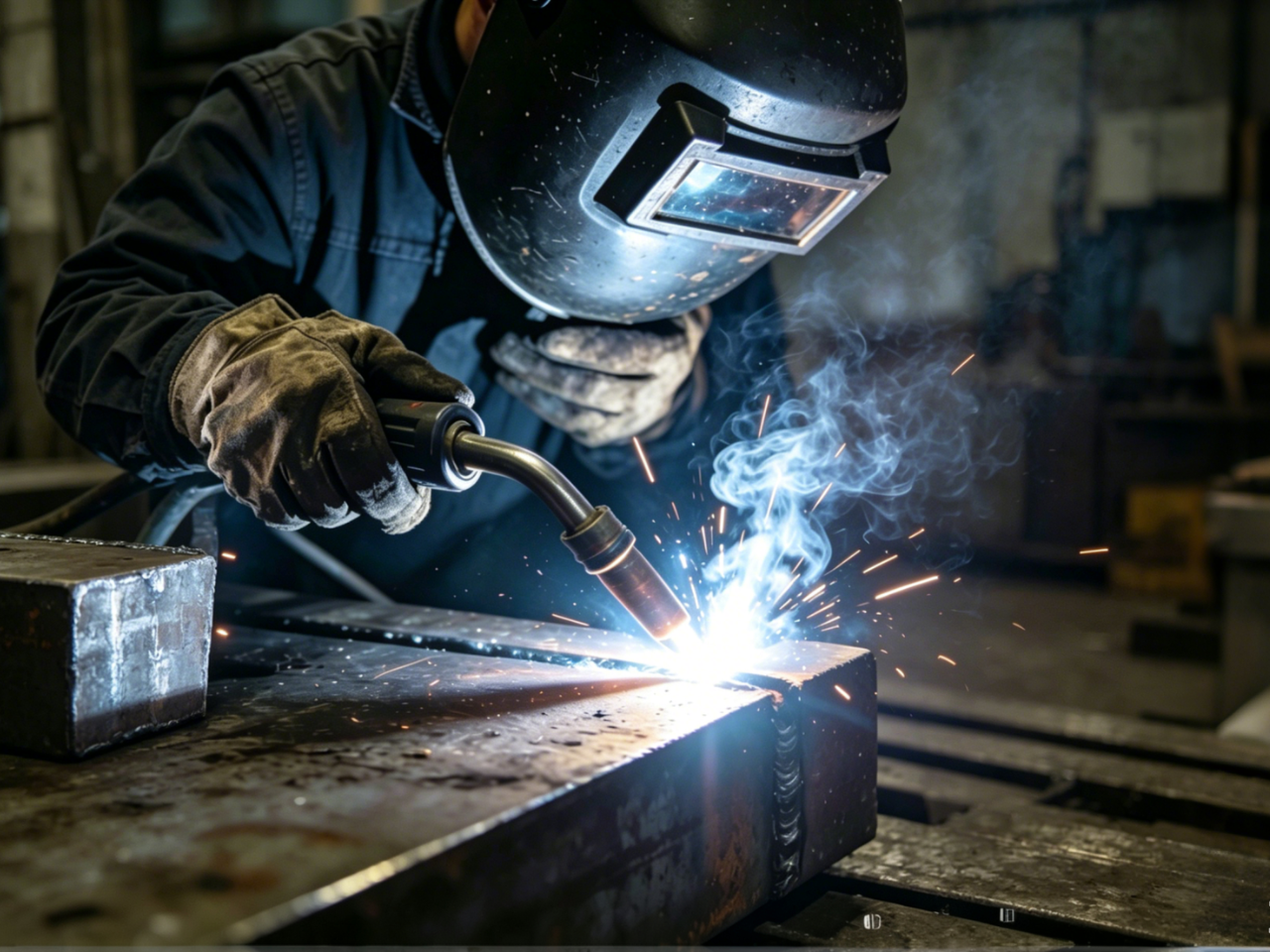
For aluminum MIG welding, always push the gun forward (gun angle pointing in the direction of travel). Pushing gives better gas coverage and a flatter, cleaner bead. Dragging ("pulling") traps slag and causes porosity.
Step 6 — Weld and Inspect
Keep a consistent travel speed and a ⅜" to ½" (10–13 mm) contact-tip-to-work distance. Aluminum conducts heat rapidly, so the base metal gets hot fast — reduce voltage slightly as you progress down a long bead. After welding, let the joint air-cool (never quench with water) and inspect for porosity, undercut, or incomplete fusion.
6. Voltage & Wire Speed Settings Chart
Use these starting points, then adjust ±10% based on your specific machine and joint fit-up. All settings are for 100% argon gas and ER4043 aluminum wire.
| Material Thickness | Wire Diameter | Voltage | Wire Speed (IPM) | Amperage (approx.) |
|---|---|---|---|---|
| 1/16" (1.5 mm) | 0.030" (ER4043) | 16–18 V | 180–220 | 80–100 A |
| 1/8" (3 mm) | 0.030" (ER4043) | 19–21 V | 240–280 | 120–150 A |
| 3/16" (5 mm) | 0.035" (ER4043) | 21–23 V | 270–310 | 160–190 A |
| 1/4" (6 mm) | 0.035" (ER4043) | 23–25 V | 300–360 | 190–230 A |
| 3/8" (10 mm) | 0.035" (ER4043) | 24–26 V | 340–400 | 230–250 A |
💡 AZZUNO Tip: The AZZUNO 250A 6-in-1 has a dedicated "Aluminum MIG" synergic mode that auto-sets voltage and wire speed based on material thickness — just dial in your metal gauge and it does the math for you.
7. Five Common Mistakes (and How to Avoid Them)
❌ Mistake #1: Using C25 Gas Instead of Pure Argon
Result: Black, porous welds that look burnt and fail inspection.
✅ Fix: Always use 100% argon for aluminum. Label your argon cylinder with tape so you never grab the wrong one.
❌ Mistake #2: Skipping the Pre-Weld Cleaning
Result: Porosity (tiny holes), incomplete fusion, and welds that crack under load.
✅ Fix: Acetone wipe + stainless brush every time. No exceptions.
❌ Mistake #3: Dragging the Gun Instead of Pushing
Result: Poor gas coverage, spatter, and an uneven bead.
✅ Fix: Point the gun in the direction of travel (push angle, 10–15° from vertical).
❌ Mistake #4: Welding Too Slowly on Thick Aluminum
Result: Burn-through or massive heat buildup, distorting the part.
✅ Fix: Aluminum conducts heat fast — move at a brisk, consistent pace. If you feel the metal getting too hot, reduce voltage by 0.5–1 V.
❌ Mistake #5: Using a Steel-Contaminated Wire Brush
Result: Iron particles embedded in aluminum = rust spots and porosity weeks later.
✅ Fix: Buy a cheap stainless brush and use it only for aluminum. Write "AL ONLY" on the handle with a marker.
8. Best AZZUNO MIG Welders for Aluminum
Not every MIG welder supports aluminum welding. You need a machine with a spool gun port. Here are the two AZZUNO models built for it:
🏆 Best Overall: AZZUNO 250A 6-in-1 Aluminum MIG Welder
Price: $459.99 → From $359.99 (currently on sale)
Why it's #1 for aluminum:
- ✅ Dedicated "Aluminum MIG" mode with synergic auto-settings
- ✅ 250A output — handles aluminum up to 10 mm (25/64") thick
- ✅ Spool gun support included — ready to weld aluminum out of box
- ✅ 6 processes: Gas MIG / Gasless MIG / Stick / Lift TIG / Spool Gun / Spot Weld
- ✅ Dual voltage 110V/220V — works anywhere
- ✅ Welds aluminum, copper, carbon steel, stainless steel, iron
| Output | 250A |
| Voltage | 110V / 220V dual voltage |
| Max aluminum thickness | 25/64" (10 mm) |
| Weight | 24.9 lbs |
| Dimensions | 18" × 9.5" × 12.6" |
Best for: Boat repairs, trailer frames, aluminum ramps, structural fabrication
→ Shop the AZZUNO 250A 6-in-1 Aluminum MIG Welder
💰 Great Value: AZZUNO 200A 8-in-1 MIG Multiprocess Welder
Price: $369.99 → From $299.99
Why it's a strong runner-up:
- ✅ Also supports spool gun for aluminum welding
- ✅ 8 processes: Flux Core / Gas MIG / MAG / Aluminum MIG / Spot / Lift TIG / Stick / Spool Gun
- ✅ 200A output — handles most aluminum jobs up to 10 mm
- ✅ Same dual voltage (110V/220V)
- ✅ $60 cheaper than the 250A model — great if 200A is enough

→ Shop the AZZUNO 200A 8-in-1 MIG Welder
Quick Pick Guide:
— Welding aluminum > 3/16" regularly → 250A 6-in-1
— Occasional aluminum repairs, mostly steel work → 200A 8-in-1
— Want the cleanest possible aluminum welds, thin sheet → consider a TIG welder
9. Frequently Asked Questions
Q: Can a regular MIG welder weld aluminum without a spool gun?
A: Technically yes, but practically no. You can try using a Teflon liner and aluminum wire through a standard MIG gun, but the soft wire will jam every few feet. A spool gun eliminates this problem by keeping the wire feed distance under 3 inches. If your welder has a spool gun port, use a spool gun — it costs $60–$150 and saves hours of frustration.
Q: What gas do I use for MIG welding aluminum?
A: Always use 100% pure argon. The C25 blend (75% argon / 25% CO₂) used for steel welding will contaminate aluminum welds and cause porosity. Flow rate: 20–25 CFH. Do not use helium blends unless you're welding in a professional shop with specific heat requirements.
Q: What wire do I use for MIG welding aluminum?
A: Two main options:
- ER4043 — Most popular. Easier to weld, lower cracking risk, good for general fabrication and repair. Start here.
- ER5356 — Stronger, better for marine applications and parts that will be anodized. Slightly harder to weld.
Wire size: 0.030" for thin (under 1/8"), 0.035" for 1/8" and thicker.
Q: Can I MIG weld thin aluminum (under 1/8")?
A: MIG welding becomes difficult below 1/8" (3 mm) because the heat input is hard to control precisely. You risk burn-through on thin sheet. For aluminum thinner than 1/8", TIG welding with AC current gives far better control. If you must MIG thin aluminum, use 0.030" wire, reduce voltage to the low end of the chart, and move quickly.
Q: Do I need to preheat aluminum before MIG welding?
A: For most MIG welding jobs, preheat is not required. However, preheating thick aluminum (over 1/2") to 250–300°F improves fusion and reduces porosity. Use a propane torch and a temperature stick to check the surface temperature. Never preheat aluminum-lithium alloys used in aerospace.
Q: Why does my aluminum weld look black and rough?
A: Three common causes:
- Wrong gas — switch to 100% argon immediately
- Contamination — clean with acetone + stainless brush before welding
- Travel speed too slow — move faster to reduce heat buildup
Q: Is MIG welding aluminum as strong as TIG?
A: When done correctly, MIG (spool gun) welds on aluminum can achieve comparable tensile strength to TIG welds in structural applications. TIG has an edge in fatigue resistance on thin sections because of better heat control. For trailers, boat hulls, and frames, a properly executed spool gun MIG weld is entirely adequate.
10. Conclusion: Yes, MIG Can Weld Aluminum — Here's the Short Version
MIG welding aluminum is absolutely achievable, and for many applications it's faster and more practical than TIG. Here's what to remember:
- You need a spool gun — no exceptions for reliable results
- Use 100% argon — never CO₂ blends
- Clean obsessively — acetone + dedicated stainless brush every time
- Push, don't pull — 10–15° push angle for best gas coverage
- Start with ER4043 — easier to learn, works for most jobs
If you want the cleanest welds on thin aluminum or critical precision parts, upgrade to a TIG welder down the line. But for structural work, repairs, and most fabrication jobs? A spool-gun-equipped MIG machine is all you need.
About the Author
AZZUNO Welding Team — Our technical content is written and reviewed by working welders with 10+ years of hands-on fabrication experience across automotive, marine, and structural applications. We test every machine we sell.

Leave a comment
This site is protected by hCaptcha and the hCaptcha Privacy Policy and Terms of Service apply.